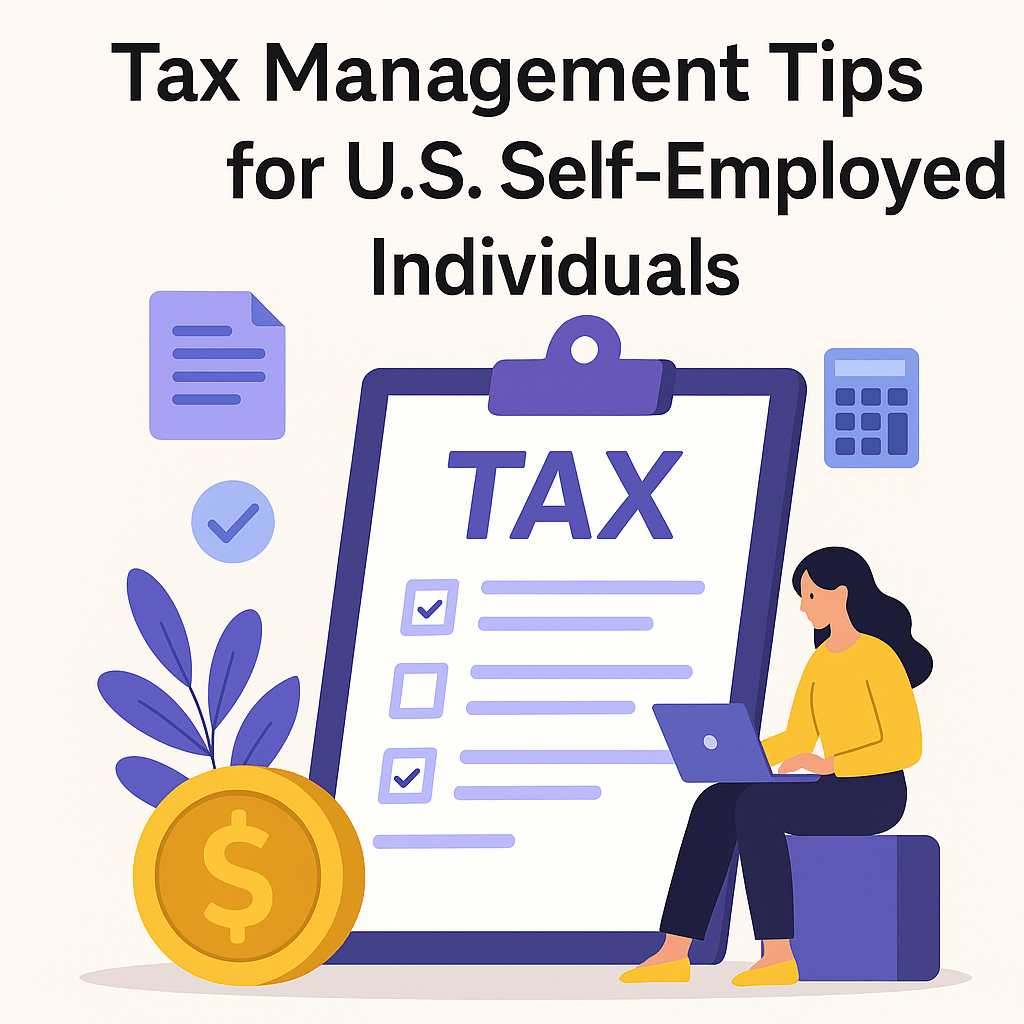
Title: Tax Management Tips for U.S. Self-Employed Individuals
Introduction
In today’s world, many people are moving away from traditional employment in favor of self-employment. Freelancers, contractors, and small business owners are thriving in the gig economy, but with that comes the responsibility of managing one’s own taxes. Self-employed individuals face unique tax challenges and opportunities, and understanding the ins and outs of tax management is crucial for success.
Why It’s Important to Manage Taxes Properly:
The IRS has specific guidelines for self-employed individuals, and failure to comply can lead to penalties, interest, and lost opportunities to reduce your tax burden.
Tax planning allows self-employed individuals to reduce their tax liability, avoid overpaying, and keep more of their hard-earned income.
In this guide, we’ll cover the key tax management tips for self-employed individuals in the U.S., including the basics of self-employment taxes, how to handle business deductions, tips for quarterly tax payments, and retirement savings options.
By the end of this post, you’ll have the tools you need to optimize your taxes, avoid costly mistakes, and build a sustainable financial future for your business.
1.1. Understanding Self-Employment Taxes
One of the first things you’ll need to grasp as a self-employed individual is the concept of self-employment taxes. Unlike traditional employees, whose tax withholding is handled by their employer, self-employed individuals must pay both income tax and self-employment tax.
Self-employment taxes consist of:
Social Security Tax (12.4%)
Medicare Tax (2.9%)
In addition, if your income exceeds $200,000 (or $250,000 for married couples filing jointly), you will owe an additional 0.9% Medicare tax.
How to calculate self-employment tax: To determine your self-employment tax, you will need to file Schedule SE along with your Form 1040. The tax is calculated based on your net income from your self-employment.
Example: If you make $50,000 in net earnings, you will owe approximately $7,650 in self-employment taxes. This doesn’t include your regular income taxes, which are calculated separately.
Strategies for Minimizing Self-Employment Taxes:
Track your expenses carefully: Deducting legitimate business expenses can lower your net income and, in turn, reduce your self-employment taxes.
Consider forming an LLC: Depending on your situation, forming a Limited Liability Company (LLC) can allow you to save on taxes by choosing the right tax structure.
1.2. Deductible Business Expenses
As a self-employed individual, you can deduct legitimate business expenses to reduce your taxable income. These deductions can help lower the amount of tax you owe.
Common deductible business expenses include:
Office supplies (computers, software, printers, etc.)
Home office expenses (rent, utilities, internet, phone bills, etc.)
Travel and meals (for business trips)
Advertising and marketing costs
Retirement plan contributions
Example: Maria is a freelance copywriter who works from her home office. She spends $2,000 annually on office supplies, and her internet and phone bills come to $1,200 per year. Since she works full-time from her home, she can deduct a portion of her rent and utilities as well. After calculating these expenses, Maria reduces her taxable income significantly, lowering her overall tax bill.
Maximizing Deductions:
Keep accurate records: It’s essential to keep receipts, invoices, and bank statements to support your deductions.
Use accounting software: Programs like QuickBooks Self-Employed and Xero help track your expenses and create financial reports.
Hire a tax professional: If you’re unsure about what you can deduct, a tax professional can help ensure you’re taking advantage of every opportunity to lower your taxable income.
1.3. Estimating and Paying Quarterly Taxes
As a self-employed individual, you’re required to pay quarterly estimated taxes. This is because no taxes are automatically withheld from your income. Paying quarterly taxes helps you avoid a large tax bill at the end of the year and penalties for underpayment.
How to calculate quarterly taxes: You can calculate your quarterly taxes by estimating your total income and deductible expenses for the year. Then, divide that amount into four payments, which are due on the following dates:
April 15
June 15
September 15
January 15 (of the following year)
1.4. Tax Deductions for Home-Based Businesses
If you run your business from home, you may be eligible for the home office deduction. This is a great way to reduce your taxable income.
What qualifies for the home office deduction?
The space must be used exclusively for business purposes.
The space must be used regularly for business, not just occasionally.
You can deduct a percentage of your rent/mortgage, utilities, and other related expenses based on the size of your office.
Example: John works from his dedicated home office that’s 200 square feet. His home is 1,500 square feet in total. Therefore, he can deduct 13.33% of his home expenses for the year. This includes rent, utilities, and internet bills.
1.5. Retirement Plans for Self-Employed Individuals
One of the great advantages of being self-employed is that you can save for retirement through specific plans that offer higher contribution limits than traditional retirement accounts.
Best retirement plans for the self-employed:
Solo 401(k): Offers the highest contribution limits. You can contribute up to $57,000 per year, or $63,500 if you’re over 50.
SEP IRA: Allows you to contribute up to 25% of your income, with a maximum of $56,000.
Simple IRA: Allows for contributions up to $13,500 per year, or $16,500 if you’re over 50.
Example: Kelly, a freelance photographer, contributes to a Solo 401(k). She is able to save $55,000 in a single year, significantly lowering her taxable income. This helps her reduce her tax bill while saving for her future.
1.6. Using Accounting Software to Simplify Your Taxes
Self-employed individuals often face the challenge of tracking income, expenses, and deductions. Fortunately, there are tools and software that can help.
Accounting software options:
QuickBooks Self-Employed: Tracks income and expenses, helps calculate quarterly taxes, and organizes receipts.
FreshBooks: Great for invoicing and tracking payments.
Xero: Offers invoicing, expense tracking, and payroll features for small businesses.
1.7. Hiring a Tax Professional
If you feel overwhelmed by the complexities of taxes, hiring a tax professional can be a wise decision. They can ensure your tax returns are filed correctly and that you’re getting the most out of your deductions.
FAQ for Tax Management Tips for Self-Employed Individuals
How can I avoid overpaying taxes as a self-employed individual?
Keep detailed records, claim all eligible deductions, and pay quarterly taxes to avoid underpayment penalties.
What business expenses can I deduct?
Common deductions include office supplies, travel expenses, home office costs, and retirement contributions.
How do I calculate my self-employment tax?
Self-employment tax is calculated using Schedule SE, and it’s based on your net earnings from self-employment.
Can I deduct my health insurance premiums?
Yes, you can deduct 100% of your health insurance premiums if you’re self-employed and not eligible for an employer-sponsored plan.
What happens if I miss a quarterly tax payment?
If you miss a quarterly tax payment, pay it as soon as possible to avoid penalties and interest. You may also need to amend your tax return.
What should I do if my business expenses exceed my income?
If your business expenses exceed your income, you can carry forward the loss to offset future taxable income.
How do I find a reliable tax professional for my business?
Look for a tax professional who specializes in self-employment taxes and has experience with small businesses.
How can I save for retirement as a self-employed individual?
You can contribute to a Solo 401(k), SEP IRA, or Simple IRA to save for retirement and reduce your taxable income.
How do I handle tax deductions for travel expenses?
You can deduct travel expenses that are directly related to business activities, including transportation, lodging, and meals.
What is the best accounting software for self-employed individuals?
Popular options include QuickBooks Self-Employed, FreshBooks, and Xero. Choose the one that best suits your business needs.
Real Case Examples:
Example 1: Freelance Graphic Designer (Sarah)
Sarah is a freelance graphic designer working from her home office. She started her business in 2017 and, after consulting with a tax professional, realized that she could deduct her home office expenses, design software subscriptions, and advertising costs. Last year, she made $75,000 in revenue, and with her deductions, she reduced her taxable income to $55,000.
Tax savings: By using the home office deduction and business expenses, Sarah saved about $7,500 in taxes. She also contributes to a Solo 401(k), reducing her taxable income even further.
Example 2: Online Retailer (David)
David runs an online store selling handmade products. He uses Shopify for sales and QuickBooks for accounting. In 2022, David made $120,000 in gross revenue. After factoring in inventory costs, shipping expenses, and website maintenance, his taxable income dropped to $90,000.
Tax savings: David saves around $10,000 by claiming deductions for business expenses. He also contributes to a SEP IRA, which lowers his taxable income by another $13,500.
Example 3: Consultant (Mark)
Mark is a business consultant who works with small and medium-sized businesses. In 2022, he had a revenue of $150,000. Mark utilizes tax software to track expenses and has found that he can deduct his business-related travel, client meetings, and even a portion of his home office rent.
Tax savings: By tracking his expenses and using a Solo 401(k), Mark saved $20,000 in taxes. He also hired a tax professional to ensure he wasn’t missing any deductions.
Example 4: Freelance Writer (Linda)
Linda, a freelance writer, writes articles for various online publications. In 2022, she earned $50,000. Linda works from her home office, and she deducts writing-related software, research costs, and home office expenses. Additionally, Linda writes off the cost of books and research subscriptions.
Tax savings: By optimizing her deductions, Linda reduced her taxable income to $40,000, saving approximately $5,000 in taxes. She also contributed to a Simple IRA to build her retirement savings.
Example 5: YouTube Content Creator (Jessica)
Jessica, a YouTube content creator, generated $70,000 in revenue last year through ads, sponsorships, and merchandise sales. Jessica also runs a merchandise store and deducts all the expenses related to the production and marketing of her items.
Tax savings: Jessica managed to deduct $18,000 for business expenses, lowering her taxable income to $52,000. She also deducts her studio equipment and software, saving $4,500 in taxes.
Example 6: Independent Photographer (Michael)
Michael, a freelance photographer, earns about $100,000 annually. He deducts expenses related to his camera equipment, editing software, and the marketing he does to get clients. He also has a home office where he edits his photos, which qualifies him for the home office deduction.
Tax savings: Michael saves around $12,000 in taxes by deducting business expenses and contributing to a SEP IRA, which further reduces his taxable income.
Example 7: Fitness Coach (Amy)
Amy is a self-employed fitness coach. She charges clients for one-on-one coaching sessions and group classes. In 2022, she generated $80,000. Amy works from a rented space and can deduct expenses related to her rent, equipment, and online coaching software.
Tax savings: Amy saves $8,000 annually through business-related deductions and also contributes $10,000 to a Solo 401(k), which reduces her tax liability.
Example 8: eBook Author (John)
John, an eBook author, writes and sells his books on Amazon Kindle. He earned $60,000 in royalties last year. John uses Calibre to format his books and Canva for cover design, both of which are deductible expenses.
Tax savings: By deducting the cost of writing tools, marketing expenses, and eBook formatting software, John reduced his taxable income by $7,500.
Example 9: Social Media Influencer (Rachel)
Rachel, a social media influencer, collaborates with brands and charges for sponsored posts. In 2022, she made $90,000 from brand partnerships, affiliate marketing, and product promotions.
Tax savings: Rachel deducted the costs of her photography gear, website hosting fees, and social media management tools, which saved her about $9,000 in taxes. Additionally, she contributes to a SEP IRA to further reduce her taxable income.
Example 10: Virtual Assistant (Sophia)
Sophia works as a virtual assistant for small business owners. She made $55,000 last year by providing administrative services. Sophia tracks her client billing and business expenses through QuickBooks Self-Employed, which helps her maximize deductions.
Tax savings: By claiming home office expenses, software subscriptions, and business-related supplies, Sophia reduced her taxable income by $6,000, saving her $1,500 in taxes.
Example 11: Real Estate Agent (Tom)
Tom is a real estate agent who made $120,000 in commissions last year. He works from a home office and spends a significant portion of his income on advertising and marketing his services. Tom also deducts the cost of client meetings, gas, and car expenses related to driving to property showings.
Tax savings: Tom saved $15,000 in taxes through business-related deductions. He also contributed $12,000 to a Solo 401(k), further lowering his taxable income.
Why These Examples Work:
The key takeaway from these examples is the importance of tracking all business-related expenses and contributing to retirement plans. In all cases, the individuals mentioned saved significant amounts on taxes by:
Deductions for business expenses: Office space, equipment, software, and supplies.
Using retirement plans: Solo 401(k)s, SEP IRAs, and Simple IRAs to reduce taxable income.
Quarterly estimated taxes: Ensuring taxes are paid throughout the year to avoid penalties.
By following the tax tips mentioned in these examples, self-employed individuals can effectively reduce their tax liabilities and maximize savings.
Disclaimer:
This document is intended for informational and exploratory purposes only.
It does not represent official advice, legal authority, or verified scientific claims.
Readers are encouraged to interpret the content thoughtfully and responsibly.
No part of this document should be used as a substitute for professional guidance in legal, medical, financial, or technical matters.
Use of this material is at the sole discretion and responsibility of the reader.
 Official Docs Guide
Leave a comment