How to Properly Prepare for U.S. Tax Filing: A Comprehensive Guide (Expanded Version)
Filing your taxes doesn’t have to be a stressful and confusing process. When approached with the right mindset and preparation, tax season can be an opportunity to maximize your savings, minimize your liabilities, and ensure you’re fully compliant with the law. The U.S. tax system is complex, and navigating it can seem overwhelming, especially for first-time filers or those with multiple sources of income. However, with the proper steps and strategies, you can manage the tax preparation process smoothly and confidently. This comprehensive guide will walk you through every essential step of preparing for U.S. tax filing, from understanding the U.S. tax system to maximizing deductions and credits, and even tips for self-employed individuals and business owners.
By breaking down the tax filing process into manageable steps, we aim to equip you with the tools and knowledge needed to make tax season a more manageable and less stressful time of year. Let’s dive into the details and start preparing!
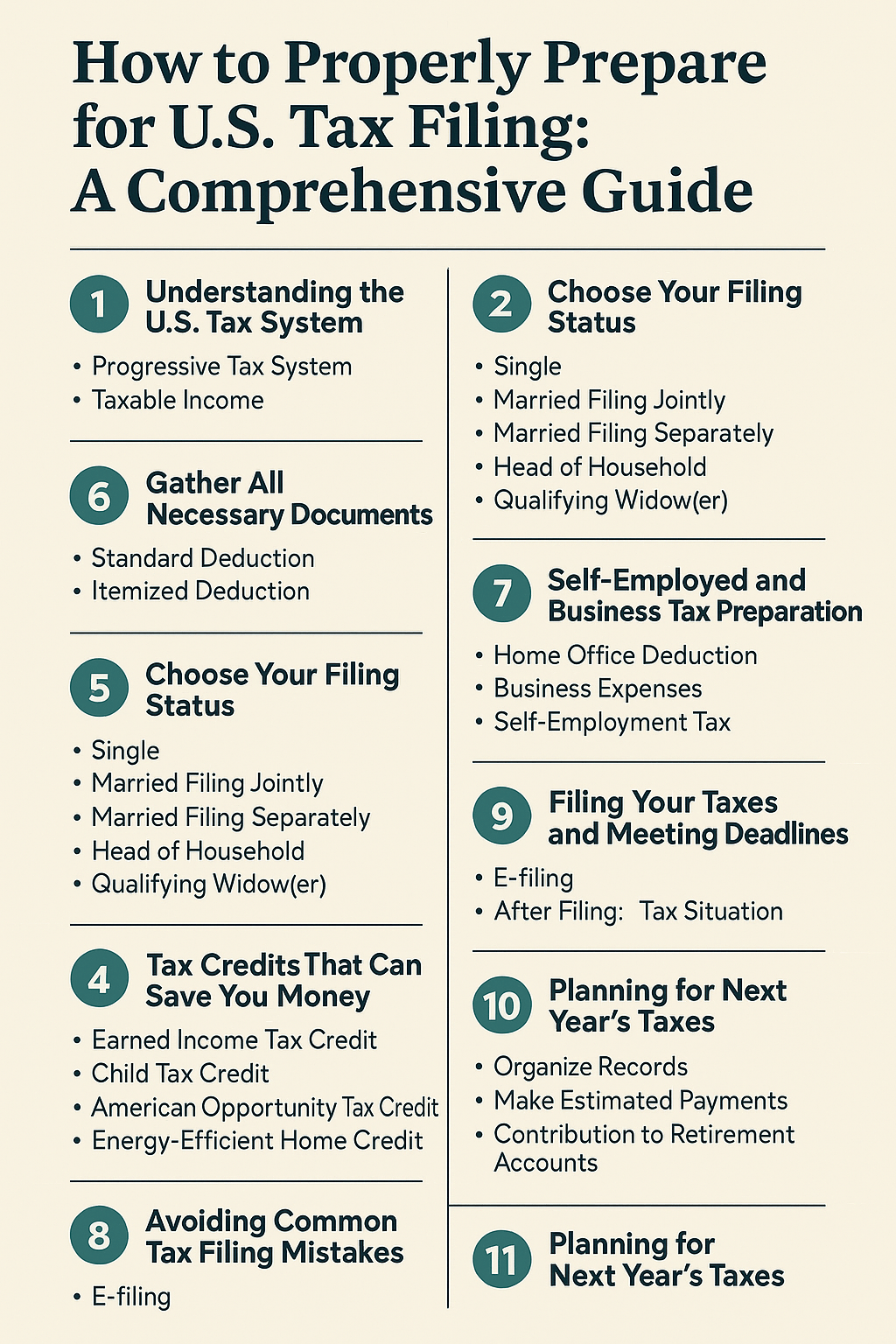
1. Understanding the U.S. Tax System
The U.S. tax system is a progressive tax system, which means the more you earn, the higher the percentage of your income you pay in taxes. Understanding this foundational principle is crucial to preparing your taxes.
At the heart of the U.S. tax system is your taxable income. Taxable income is your total income from all sources—such as wages, interest, dividends, and capital gains—minus any applicable deductions, exemptions, and credits.
The IRS (Internal Revenue Service) is the body responsible for enforcing tax laws and collecting taxes. The taxes collected by the IRS support federal programs such as national defense, education, healthcare, and infrastructure.
In addition to federal income taxes, most states also impose income taxes, though the tax rates and rules vary by state. Some states, like California and New York, have high tax rates, while others, like Texas and Florida, have no state income tax.
Income taxes in the U.S. are based on tax brackets, meaning your income is taxed at different rates as it increases. For instance:
• The lowest federal tax bracket is 10% for the first portion of your taxable income, while the highest rate is 37% for income above a certain threshold.
Additionally, Self-Employment Tax applies to individuals who are self-employed or freelancers. Self-employment taxes are essentially the Social Security and Medicare taxes that employers typically pay, but self-employed individuals must cover both portions.
2. Key Deadlines for Tax Filing
Tax filing deadlines are an important aspect of the preparation process. If you don’t file or pay your taxes on time, you could face penalties and interest.
• Filing Deadline: In most years, the filing deadline for federal income taxes is April 15. If April 15 falls on a weekend or holiday, the IRS typically extends the deadline to the next business day.
• Extension: If you need more time to file your return, you can request an extension. The IRS grants a 6-month extension, pushing the deadline to October 15. However, an extension to file does not extend the time to pay any taxes owed, so you will still need to pay by the original deadline to avoid late payment penalties and interest.
• Estimated Payments: For self-employed individuals or those with other non-wage income, you may be required to make quarterly estimated payments to avoid underpayment penalties.
It’s crucial to stay on top of the deadlines to avoid penalties and ensure you’re filing and paying on time. Filing late could result in an automatic penalty of 5% of the unpaid tax per month, up to a maximum of 25%.
3. Gathering the Necessary Documents for Tax Filing
One of the most important steps in preparing for tax filing is collecting all the necessary documents. The IRS requires you to report your income, deductions, and credits accurately, and having the proper documents ensures a smooth process.
The documents you will need to gather include:
• W-2 Forms: If you are employed, your employer will provide you with W-2 Forms, which report your income, the federal income tax withheld, and Social Security and Medicare contributions. These forms must be issued by January 31 each year.
• 1099 Forms: If you’re a freelancer, contractor, or receive other types of non-salary income, you may receive one or more 1099 Forms. Common types include 1099-NEC (non-employee compensation), 1099-DIV (dividends), and 1099-INT (interest income). Make sure to report all 1099 forms to the IRS to ensure you’re properly taxed on all your income.
• Investment Documents: If you have investments, you will need to gather documents related to your investment income, such as Form 1099-B for stock or mutual fund transactions, Form 1099-DIV for dividends, and Form 1099-INT for interest.
• Mortgage Interest Statements (Form 1098): If you own a home and have a mortgage, your lender will send you Form 1098, which shows the amount of mortgage interest you’ve paid. You may be able to deduct this interest on your taxes.
• Charitable Contributions: If you donated to charitable organizations, you can deduct these contributions, provided you have receipts. Keep records of all donations.
• Medical Expenses: If you paid out-of-pocket for medical expenses, you may be able to deduct them. Keep track of all receipts and statements from your healthcare providers.
• Retirement Accounts (Form 5498): If you contributed to an IRA or 401(k) during the year, you’ll need Form 5498 to report those contributions.
Having all these documents prepared before you file your taxes will make the process much smoother and less stressful.
4. Choosing Your Filing Status
Your filing status determines how much tax you pay and what deductions and credits you can claim. The IRS recognizes five possible filing statuses:
• Single: For individuals who are unmarried or legally separated.
• Married Filing Jointly: If you’re married, this status allows you and your spouse to combine your income and deductions on a single tax return. This status typically results in a lower tax rate and greater tax benefits.
• Married Filing Separately: If you’re married but want to file separately, this option may be beneficial in certain circumstances, like when one spouse has substantial medical expenses.
• Head of Household: This applies to unmarried individuals who provide a home for a dependent, such as a child. It offers more favorable tax rates than the single filing status.
• Qualifying Widow(er) with Dependent Child: If your spouse passed away in the last two years, and you have a dependent child, this status allows you to file as a qualifying widow(er) and receive the same tax benefits as married couples filing jointly.
Your filing status impacts the tax rates you’ll face and the deductions you can claim. It’s important to choose the right filing status to maximize your tax benefits.
5. Standard vs. Itemized Deductions
You can reduce your taxable income by claiming deductions. There are two ways to do this: you can either take the standard deduction or itemize your deductions.
• Standard Deduction: The standard deduction is a fixed amount that the IRS allows you to deduct from your taxable income. For 2024:
• $13,850 for single filers
• $27,700 for married couples filing jointly
• Itemized Deductions: If your deductible expenses exceed the standard deduction, you may choose to itemize. Common itemized deductions include:
• Mortgage Interest
• State and Local Taxes (SALT): You can deduct up to $10,000 for state and local taxes.
• Charitable Contributions: Donations to qualified charitable organizations are deductible.
• Medical Expenses: If your medical expenses exceed 7.5% of your adjusted gross income, you can deduct the excess.
Itemizing your deductions can be beneficial, but it requires careful record-keeping and documentation.
6. Tax Credits to Lower Your Tax Bill
Unlike deductions, which reduce your taxable income, tax credits reduce the actual amount of tax you owe. Some of the most common and valuable tax credits include:
• Earned Income Tax Credit (EITC): A refundable credit designed to help low- and moderate-income earners, especially those with children. It’s one of the most powerful credits available.
• Child Tax Credit: Worth up to $2,000 per qualifying child under the age of 17.
• American Opportunity Tax Credit: Worth up to $2,500 per eligible student, this credit helps cover the costs of higher education.
• Energy-Efficient Home Credit: If you’ve made energy-efficient upgrades to your home, such as installing solar panels, you may be eligible for this credit.
Tax credits are highly valuable because they directly reduce the amount of tax you owe. Make sure you take full advantage of any credits you’re eligible for.
7. Self-Employment and Business Owner Tax Preparation
For self-employed individuals, freelancers, and business owners, tax preparation can be more complex due to the additional deductions and tax responsibilities.
Key areas for self-employed taxpayers:
• Self-Employment Tax: Self-employed individuals must pay both the employee and employer portions of Social Security and Medicare taxes, which amounts to 15.3% of your net earnings.
• Business Expenses: Self-employed individuals can deduct a wide range of business expenses, such as office supplies, travel expenses, and marketing costs.
• Home Office Deduction: If you work from home, you may be able to claim a portion of your rent, utilities, and internet costs as a deduction.
By keeping detailed records and making quarterly estimated payments, you can avoid penalties and ensure that you’re fully compliant with tax regulations.
8. What to Do After Filing
Once you’ve filed your tax return, there are a few important steps to take:
• Track Your Refund: You can use the IRS “Where’s My Refund?” tool to check the status of your refund.
• Pay Taxes Owed: If you owe taxes, make sure to pay them by the deadline to avoid interest and penalties.
• Keep Your Records: Store copies of your tax return and supporting documents for at least three years in case you need them for future reference or in case of an audit.
9. Tax Planning for the Future
Tax planning is a year-round activity. To reduce your tax burden next year, consider strategies such as contributing to retirement accounts, making estimated quarterly payments if you’re self-employed, and keeping track of your deductible expenses. Regular tax planning helps ensure that you don’t face a big surprise at the end of the year.
10. FAQ (Frequently Asked Questions) About Tax Filing
Here are some common questions that taxpayers often have about tax filing:
Q: Can I file my taxes online for free?
A: Yes, there are many free e-filing options available, especially for those with simple returns. The IRS offers a Free File Program, which allows eligible taxpayers to use tax preparation software for free. Many online tax preparation services also offer free filing for simple returns.
Q: What should I do if I can’t pay my taxes on time?
A: If you cannot pay your taxes by the due date, consider setting up a payment plan with the IRS. The IRS offers installment agreements, which allow you to pay your tax liability over time. However, interest and penalties will still apply, so it’s best to pay as much as possible by the deadline to minimize extra charges.
Q: Can I deduct student loan interest?
A: Yes, you can deduct up to $2,500 in student loan interest each year, provided you meet certain income requirements. This is an above-the-line deduction, which means you don’t need to itemize your deductions to claim it.
Q: Do I need to report all my income?
A: Yes, you must report all income, including wages, freelance earnings, investment income, and any other sources of income. Even if you don’t receive a W-2 or 1099, you’re still required to report the income.
11. Recent Tax Law Changes and What They Mean for You
Tax laws can change every year, and understanding the most recent changes can help you optimize your filing. Here are some recent updates that may impact your tax return:
• Tax Cuts and Jobs Act (TCJA): This legislation, enacted in December 2017, made several changes, including lowering tax rates, expanding the standard deduction, and limiting state and local tax deductions.
• COVID-19 Relief Measures: The American Rescue Plan (2021) provided direct stimulus payments, expanded child tax credits, and temporary changes to unemployment benefits. Be sure to check if you qualify for any of these relief measures in your filing.
•
Conclusion
Proper preparation and knowledge are key when it comes to filing your taxes. By understanding the tax system, gathering the right documents, and using tax strategies to minimize your liability, you can ensure that your tax filing experience is smooth and stress-free. Whether you are self-employed, a freelancer, or a business owner, following these steps will help you take control of your taxes and optimize your filing.
Disclaimer:
This document is intended for informational and exploratory purposes only.
It does not represent official advice, legal authority, or verified scientific claims.
Readers are encouraged to interpret the content thoughtfully and responsibly.
No part of this document should be used as a substitute for professional guidance in legal, medical, financial, or technical matters.
Use of this material is at the sole discretion and responsibility of the reader.
 Official Docs Guide
Leave a comment